

Stargazing in the Alps: Why the Sky Gets Better as Summer Ends
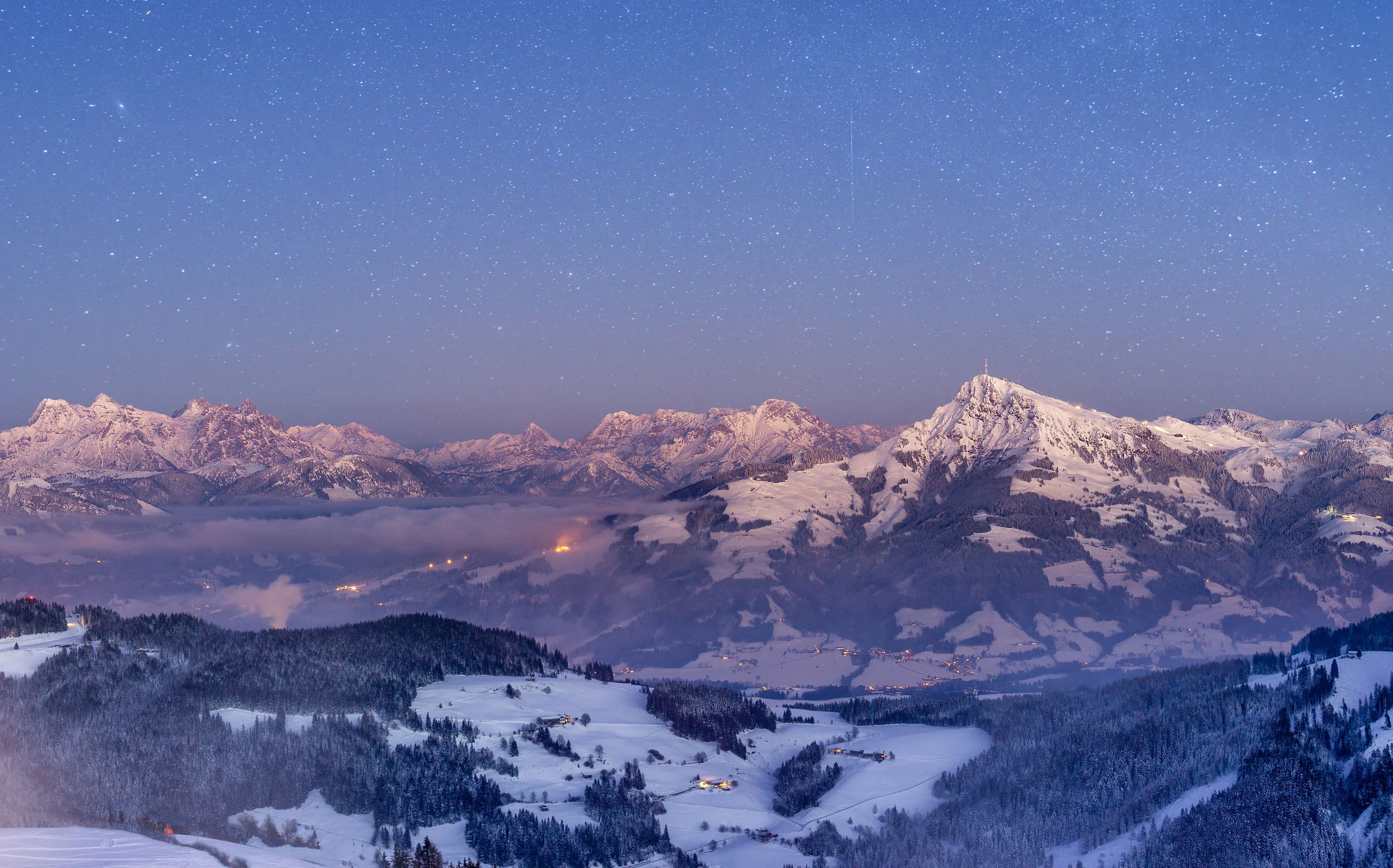
There is a moment each year when the Alps suddenly feel different at night.
Stargazing in the Alps: Why the Sky Gets Better as Summer Ends
There is a moment each year when the Alps suddenly feel different at night.
The last warm days of summer are still here. Dew is already settling on the meadows. The mountain lifts are still operating, the mountain huts are open, and after sunset everything becomes noticeably quieter.
Then the sky begins.
First, a single bright star appears. Then a second. Eventually, the dark blue turns into deep black, filled with countless points of light.
Stargazing in the Alps becomes particularly appealing from late summer onward. The main reason is not that the sky is automatically clearer in autumn. It is the combination of longer nights, less daylight, favorable lunar phases, alpine viewpoints, and the opportunity to observe far away from strong artificial lighting.
For Kitzbühel and the Kitzbühel Alps, this is a particularly special time of year.
The Quick Answer: Why Do the Starry Nights Get Better After Summer?
If you only want to know the most important points:
The nights get longer. After the summer solstice, the amount of daylight decreases again. This means more time for genuine darkness.
Astronomical twilight ends earlier. By the end of September, the Sun spends significantly less time above the horizon.
The Moon matters. Around the new moon, the sky is particularly favorable for observing faint objects.
The Alps offer many darker locations. The farther you get from cities and brightly illuminated valleys, the more stars you can see.
The September sky is astronomically fascinating. The Milky Way, the Summer Triangle, and numerous constellations remain visible while the autumn sky is already beginning to emerge.
The result is an experience that requires surprisingly little equipment.
You simply need to know when and where to look.
Why Late Summer Is So Special for Stargazing
Longer Nights, More Time Under the Stars
In June and July, a starry night in the Alps can surprisingly feel quite short.
The Sun sets late. Twilight lingers. And anyone waiting for a truly dark sky has to stay up late.
In September, the rhythm changes significantly.
In Kitzbühel, the Sun sets at around 7:50 p.m. at the beginning of September 2026. By mid-September, sunset is already around 7:22 p.m. At the same time, astronomical darkness arrives earlier.
Around the equinox on September 22, day and night become increasingly balanced.
For travelers, this is ideal.
You can hike, play golf, or explore the mountains during the day without having to wait until midnight to experience a truly dark sky.
Less Twilight, More Darkness
For astronomy, sunset is not the only thing that matters.
What matters is how far below the horizon the Sun is. Only once astronomical twilight has ended does the sky become dark enough to make fainter stars and diffuse structures clearly visible.
This is where autumn has an advantage.
The nights become longer, and the amount of time with a deep, dark sky increases. This is particularly valuable when observing the Milky Way or using binoculars to look for star clusters and nebulae.
The Moon Is Just as Important as Light Pollution
A common mistake when stargazing is to pay attention to the weather but forget about the Moon.
A bright Moon can significantly brighten the sky. Faint stars and the delicate structures of the Milky Way are then more easily lost in the moonlight. NASA therefore recommends considering the lunar phase as well as moonrise and moonset when planning observations of the Milky Way and other faint objects.
For the darkest nights, the strongest combination is therefore:
New moon + clear skies + as little artificial light as possible.
In September 2026, the new moon in Austria falls on September 11. The full moon follows on September 26.
If you can plan your trip flexibly, it therefore makes sense to look not only at the weather forecast but also at the lunar calendar.
Why the Alps Offer Ideal Conditions
A high mountain is not automatically a perfect stargazing location.
This is a common misconception.
Altitude can help because you are above part of the atmosphere close to the ground. But even more important is how much artificial light is brightening the sky.
The European Southern Observatory (ESO) explains the effect simply: the brighter the sky becomes because of light pollution, the fewer stars are visible. Artificial light is scattered in the atmosphere and creates what is known as skyglow.
Altitude Alone Does Not Create a Dark Sky
A viewpoint directly above a brightly illuminated city can be worse than a slightly lower location in a remote side valley.
For a good night of stargazing, look for:
- as little artificial light as possible
- an unobstructed view of the sky
- minimal light directly in your field of view
- sufficient distance from settlements
- stable weather conditions
- as little moonlight as possible
This is precisely why remote alpine valleys are so interesting.
Distance from Artificial Light Is Crucial
In the Kitzbühel Alps, there are locations specifically used for astronomical observations.
One example is the area around Labalm in the Spertental valley near Kirchberg in Tyrol. The provider sternenguide.tirol describes the location as one of the darkest places in the Kitzbühel Alps that can be reached by car. Public stargazing tours with telescopes and astronomical binoculars are held there.
This is particularly interesting for travelers who do not simply want to see "lots of stars" but actually want to understand what they are looking at.
Which Stars and Celestial Objects Can You See in September?
September is not an astronomical vacuum between summer and autumn.
Quite the opposite.
It is a transitional period with a particularly varied sky.
The Milky Way
For many people, the Milky Way is the real reason to head into the mountains.
Under a truly dark sky, it does not appear as a single bright stripe but rather as a broad, milky band made up of countless stars.
NASA highlights the region around Sagittarius and the so-called "Teapot" as particularly interesting in September. From a dark location, you can identify the direction toward the center of our Milky Way.
It is one of those moments when a mountain holiday suddenly takes on another dimension.
The Summer Triangle
Vega, Deneb, and Altair form what is known as the Summer Triangle.
Although its name suggests midsummer, this star pattern remains clearly visible in September. It stands high above the horizon in the evening and provides an excellent reference point for beginners.
If you are consciously observing the stars for the first time, this is a good place to start.
Sagittarius and the Center of the Milky Way
On September evenings, look toward the south and southwest.
This is where the region of Sagittarius can be found. The center of our galaxy lies in this direction.
The view becomes particularly fascinating with binoculars. Suddenly, what appeared to be just a few stars turns into countless individual points of light.
NASA also recommends looking toward this region in September, particularly under dark skies.
Planets, Star Clusters, and Nebulae
A telescope takes the experience to another level.
Depending on the night and the position of the celestial objects, a guided stargazing session may include planets, star clusters, nebulae, and galaxies.
This is one of the advantages of a professionally guided stargazing experience: you do not first have to learn which point of light in the sky is what.
September and October in Kitzbühel: The Best Time for a Night Under the Stars
Kitzbühel has another advantage in early autumn.
During the day, the region can still feel very much like late alpine summer.
The region continues to offer numerous hiking opportunities in September and October. With the KitzCard, one uphill and downhill journey per day on the Kitzbühel mountain lifts is also included during these months.
Mountains by day.
Stars by night.
That is what makes this period so appealing.
Current Stargazing Tours in the Kitzbühel Alps
Those who want to experience stargazing professionally can plan a guided tour at Labalm in the Spertental valley.
According to the current event calendar, the following dates have been published for 2026:
| Date | Start time | Location |
|---|---|---|
| September 4, 2026 | 9:00 p.m. | Alpengasthaus Labalm |
| October 2, 2026 | 7:30 p.m. | Alpengasthaus Labalm |

The tour lasts approximately 2.5 to 3 hours. The current price is €75 for adults and €39 for children up to age 15. Driving along the toll road from Aschau costs an additional €5 per car. The tour does not take place in heavily overcast or rainy conditions.
Since dates, prices, and availability can change, you should check the provider's current information before traveling.
Tip: If you are planning a stay at Schlosshotel Kitzbühel, it is worth coordinating your plans with the guest relations team in advance. This allows you to combine the stargazing experience elegantly with a day of hiking, time at the spa, and dinner.
What Is Happening in the Sky in 2026?
September 2026 is particularly interesting astronomically.
NASA highlights several events, including the period from September 14 to 20 as a good time to use the Moon as a guide to Antares and the Sagittarius region. On September 18, Venus reaches its greatest brightness for this evening appearance. The equinox follows on September 22. On September 26, the Harvest Moon appears near Saturn and Neptune.
For lovers of dark skies, the first half of September is particularly interesting.
A bright full moon may be beautiful, but it is not necessarily ideal for seeing the faintest stars.
How to Plan the Perfect Night of Stargazing
A good night under the stars requires surprisingly little.
Above all, it requires the right conditions.
1. Check the Lunar Phase
Moonless nights are particularly suitable for observing the Milky Way and faint celestial objects.
A nearly full Moon can significantly brighten the sky.
2. Check the Weather and Clouds
A dark location is of little use if it is covered by a solid layer of clouds.
In the afternoon, check again:
- cloud cover
- precipitation
- wind
- visibility
- temperature
NASA also recommends checking the weather and local conditions before setting out.
3. Choose the Darkest Possible Location
Leave brightly illuminated town centers behind.
Even better is a remote valley or mountain location with as little artificial light as possible.
4. Give Your Eyes Time to Adjust to the Darkness
The human eye needs time to adapt to darkness.
Avoid bright phone screens while observing.
Even better: put your smartphone away.
This is not only useful for astronomy. It also changes the atmosphere of the evening.
5. Dress Warmly and Comfortably
Even after a mild September day, a mountain night can become cold.
Bring:
- warm jacket
- extra layer
- hat
- sturdy shoes
- blanket or sitting mat
- thermos
- red-light flashlight, if available
6. Do Not Leave Too Quickly
The first look at a truly dark sky can be surprising.
After ten or twenty minutes, however, you will see significantly more.
Give your eyes time.
Astrophotography in the Alps
The Kitzbühel Alps are also interesting for astrophotography.
A smartphone can already capture surprisingly impressive images under a dark sky. For more ambitious photographs, a camera with manual settings, a fast lens, and a sturdy tripod are useful.
For the Milky Way, there is a simple rule:
The darker the sky, the better the camera can separate faint structures from the background.
Once again, light pollution plays a major role. A bright sky reduces contrast and causes faint details to disappear.
For travelers, it is also important to remember that astrophotography requires patience.
The best image rarely happens on the first attempt.
What You Need for a Luxury Night Under the Stars
Luxury and stargazing are not opposites.
Quite the contrary.
The appeal lies in combining the comfort of a hotel with an experience that takes place completely outside the usual hotel routine.
An ideal evening in Kitzbühel might look like this:
A late afternoon hike in the Kitzbühel mountains.
Return to Schlosshotel.
Time at the Momentum Spa.
Early dinner.
Prepare warm clothing and binoculars.
Drive to a dark observation site.
Two to three hours beneath the starry sky.
Return to the hotel and enjoy one final quiet evening drink.
This turns "stargazing" into an entire day of travel.
And that is precisely the strength of an alpine luxury trip in early autumn: the mountains are not merely a backdrop. They determine the rhythm.
Why Stay at Schlosshotel Kitzbühel for This Experience?
Schlosshotel Kitzbühel is particularly well suited as a base for a night of stargazing if you want to combine a nature experience with comfort.
The resort is located in Kitzbühel and combines alpine activities with a comprehensive wellness offering. For a stay focused on stargazing, the Momentum Spa is a particularly natural addition to the itinerary. After a hike or a long day in the mountains, it provides a peaceful counterpoint. Facilities include a sauna, pool, and fitness areas.
The rooms and suites are also designed for relaxation after an active day. Some categories feature balconies or terraces with views across the Tyrolean landscape.
When it comes to dining, you can shape the evening according to your preferences. Schlosshotel offers several culinary concepts. DAS Kaps is located directly on the golf course and combines a terrace, mountain views, and cuisine centered around fire. Rōzu focuses on sushi and Asian cuisine. The STREIF restaurant offers breakfast and dinner with live cooking.
For a stay in September or early October, the combination of hiking, wellness, and a night-time stargazing tour is particularly appealing.
Discover the Rooms and Suites at Schlosshotel Kitzbühel
Discover the Momentum Spa
When Is the Best Time for Stargazing in the Alps?
There is no single perfect month.
But September and October are particularly attractive for many travelers.
The nights are already significantly longer than in midsummer, while the days can still be pleasant for hiking and other outdoor activities.
For maximum darkness, you should also pay attention to the lunar phase.
For particularly ambitious observers, late autumn and winter nights can also be fascinating. The nights are even longer then, but temperatures are considerably lower.
Late summer therefore offers perhaps the best compromise.
The Real Secret of the Alpine Night Sky
The best starry sky does not appear simply because you drive up a mountain.
It results from several factors:
Darkness. Altitude. Weather. Lunar phase. Distance from artificial light. And time.
Autumn improves one of these factors in particular: the amount of available darkness.
And it changes something else, too.
The mountains become quieter.
The trails empty out. The evenings become longer. After sunset, there is more space for a sky that can easily be overlooked in midsummer.
So if you visit Kitzbühel in September or October, it is worth looking beyond your daytime itinerary.
Look up at night, too.
Check availability at Schlosshotel Kitzbühel and make your own night under the stars part of your stay.
Contact or Book Directly with Schlosshotel Kitzbühel
6. Key Takeaways
- September and October are excellent months for stargazing in the Alps because the nights become significantly longer.
- A dark sky does not depend on altitude alone. Light pollution is crucial.
- Moonless nights around the new moon are particularly suitable for observing theMilky Way and faint celestial objects.
- The September sky offers the Milky Way, the Summer Triangle, Sagittarius, star clusters, and other deep-sky targets.
- In the Kitzbühel Alps, Labalm in the Spertental valley is an established location for guided stargazing.
- A good night of stargazing begins with checking the weather and lunar phase.
- For a luxury trip, stargazing can be combined perfectly with hiking, the Momentum Spa, and fine dining at Schlosshotel Kitzbühel.
- Ultimately, the greatest luxury is not more equipment, but time, peace, and a trulydark sky.
7. Frequently Asked Questions
When is the best time to see the stars in the Alps?
September and October are particularly appealing because the nights are already significantly longer than in midsummer, while the days are often still suitable for alpine activities. For observing the Milky Way, you should also choose a night with littlemoonlight. Around the new moon, the sky is particularly dark, provided that weather and light pollution are favorable. NASA recommends taking the lunar phase, moonrise, and moonset into account when planning observations.
Can you see the Milky Way with the naked eye in the Alps?
Yes. At a sufficiently dark location, the Milky Way is visible to the naked eye. How clearlyit appears depends heavily on artificial light, moonlight, weather, and how well your eyes have adapted to the darkness. Remote alpine valleys offer significantly better conditions than brightly illuminated town centers. NASA describes a dark sky as a crucial factor for seeing the Milky Way.
Is autumn really better for stargazing than summer?
Not in every respect. Autumn does not guarantee clearer nights. Its major advantage is the longer period of darkness. In September and October, darkness arrives earlier and astronomical night lasts longer. At the same time, many summer constellations remainvisible. Autumn therefore offers an especially good balance between enjoyable daytime activities and long nights of observation.
Do you need a telescope for stargazing?
No. Your eyes alone are enough to enjoy an impressive night sky. Binoculars are alreadya major step up and make many stars, star clusters, and other structures easier to see. A telescope is particularly worthwhile if you want to observe specific planets, nebulae, orother deep-sky objects. Guided stargazing tours can also help you learn how to use the equipment properly.
Where can you go stargazing around Kitzbühel?
Dark, remote areas away from brightly illuminated settlements are particularlyinteresting. Labalm in the Spertental valley near Kirchberg in Tyrol is described by sternenguide.tirol as one of the darkest places in the Kitzbühel Alps that can be reached by car. Public stargazing tours with professional telescopes and astronomical binocularsare held there.
Which lunar phase is best for observing the Milky Way?
For the Milky Way and faint celestial objects, nights around the new moon are particularly favorable. The reason is simple: the Moon adds light to the sky and can overpower faint stars. The sky is therefore considerably brighter around the full moon. NASA recommends checking the lunar phase as well as moonrise and moonset times for these observations.
What should you bring to a night of stargazing in the mountains?
Warm clothing is more important than extensive equipment. A spare jacket or fleece layer, sturdy shoes, a hat, sitting mat, and warm drink are recommended. Binoculars can also be useful. If you want to take photographs, bring a sturdy tripod and a fully chargedbattery.
Can you see any special celestial events from Kitzbühel in September 2026?
Yes. NASA highlights several interesting events in September 2026. These include the region around Antares and Sagittarius in mid-September, Venus reaching particularly high brightness on September 18, the equinox on September 22, and the Harvest Moonnear Saturn and Neptune on September 26.
Are there guided stargazing tours in the Kitzbühel Alps?
Yes. For 2026, sternenguide.tirol has published public stargazing tours at Labalm in theSpertental valley. The tours last approximately 2.5 to 3 hours. The current price is €75 for adults and €39 for children up to age 15. The provider lists October 2 as another 2026 date following the September tour. Weather-related changes are possible.
Is Kitzbühel suitable for a luxury stargazing holiday?
Yes. Kitzbühel is particularly well suited to combining stargazing with an alpine wellnessand culinary holiday. After a hike, guests at Schlosshotel Kitzbühel can spend time at the Momentum Spa and enjoy dinner. A stargazing tour or visit to a dark-sky locationcan then follow. This turns a night under the stars into a complete late-summer or autumn day in the Alps.